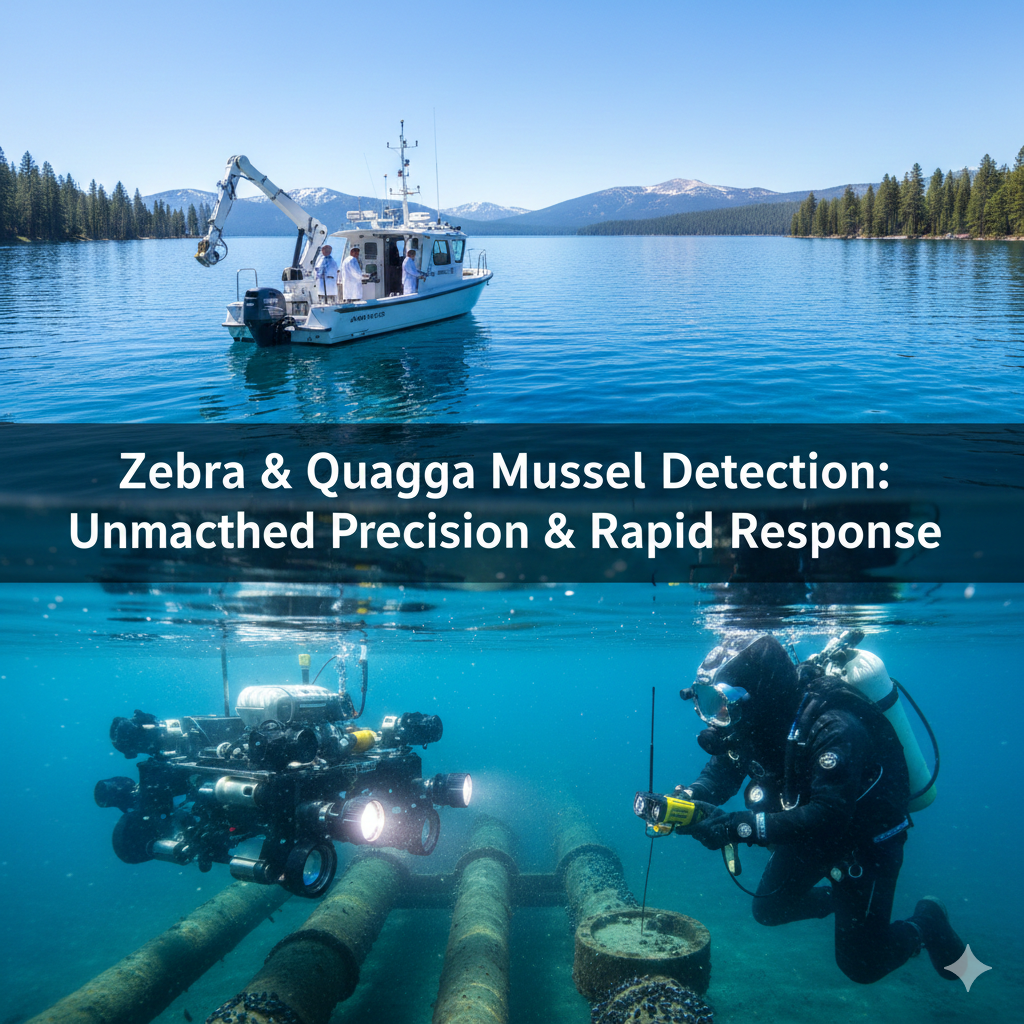
Zebra & Quagga Mussel Detection Services
Professional dreissenid mussel monitoring for Western water systems — early detection surveys, rapid response verification, and comprehensive documentation using divers, ROV, plankton tows, and eDNA sampling
Emergency: (775) 230-1116 Request ProposalThe West’s Most Costly Aquatic Invaders
Zebra and quagga mussels spread westward from the Great Lakes through contaminated watercraft, reaching the Colorado River system in 2007. These tiny mollusks multiply explosively — forming colonies of tens of thousands per square meter that clog water infrastructure, foul boats and equipment, harm native ecosystems, and cost millions annually in control measures.
🚨 Once Established, Eradication is Impossible
No water system in the United States has ever successfully eradicated an established dreissenid mussel population. Lake Mead spends over $20 million annually managing quagga mussels that arrived in 2007 — and that cost will continue forever. Prevention through early detection is the only viable strategy. A single female quagga mussel produces one million eggs per year. Detection when populations are in the hundreds allows rapid response. Detection when populations reach millions means permanent infestation.
Multi-Method Detection Strategy
Different life stages and population densities require different detection methods. We deploy the right combination of techniques to maximize detection probability and provide defensible documentation.
Diver & ROV Visual Surveys
Target: Adult and juvenile mussels (settlers)
Best for: Confirming established populations, assessing density, documenting substrate colonization
- Intake structure inspection
- Artificial substrate retrieval and examination
- Natural substrate surveys (rocks, wood, vegetation)
- Shoreline drawdown surveys
- Hand collection for laboratory confirmation
- 4K HD video and photographic documentation
Plankton Tow Sampling
Target: Veliger larvae (microscopic free-floating stage)
Best for: Detecting active reproduction, seasonal monitoring, early population growth assessment
- Vertical and horizontal plankton tows
- WRP protocol-compliant collection
- Sample preservation and chain-of-custody
- Cross-polarized light microscopy (CPLM)
- PCR molecular confirmation
- Veliger density quantification
Environmental DNA (eDNA)
Target: Species-specific DNA fragments in water
Best for: Ultra-early detection at extremely low densities before other methods succeed
- Sterile water sample collection
- Field filtration or lab submission
- qPCR analysis for species confirmation
- Detection at <10 individuals per waterbody
- Rapid turnaround (7–14 days)
- Lowest false-negative rate
Artificial Substrate Deployment
Target: Settling juveniles (new colonization)
Best for: Long-term monitoring, early settlement detection, standardized annual surveys
- PVC, concrete, or limestone substrate deployment
- 4–8 week exposure periods
- GPS-marked retrieval locations
- Microscopic examination for settlers
- Seasonal or annual monitoring programs
- Year-over-year population trend data
📊 Recommended Monitoring Approach
High-Risk Waterbodies: Quarterly eDNA + monthly plankton tows during warm months + annual artificial substrate deployment
Medium-Risk Waterbodies: Bi-annual eDNA + quarterly plankton tows + annual substrate deployment
Low-Risk / Baseline Waterbodies: Annual eDNA + artificial substrate deployment with visual inspection
We design monitoring frequency and methods based on your waterbody’s invasion risk, upstream connectivity, boat traffic, water chemistry, and budget constraints.
Rapid Response to Suspect Detections
⚡ When to Call for Emergency Verification
- Positive eDNA detection requiring confirmation
- Suspected veliger in plankton tow sample
- Visual sighting of suspect adult mussel
- Neighboring waterbody confirms new infestation
- Unexplained pipe fouling or flow reduction
- State agency requests immediate assessment
🚀 Our Rapid Response Protocol
- 24-Hour Initial Contact: Assess situation and mobilize
- 48–72 Hour Deployment: On-site with team and equipment
- Multi-Method Verification: Visual surveys + plankton + eDNA
- Same-Day Preliminary Findings: Verbal report to decision-makers
- 7-Day Final Report: Complete documentation with specimens
- Agency Coordination: State AIS coordinator notification
⚠️ The 90-Day Window for Rapid Response
Early detection rapid response (EDRR) programs work best when populations are detected within the first breeding season. A single founding population of 100 mussels can produce 100 million offspring in one year under optimal conditions. Detection and response within 90 days of initial colonization — before first reproduction — gives the best chance of successful eradication or containment. Every month of delay allows exponential population growth.
Western States Mussel Monitoring
Based in Lake Tahoe, we provide dreissenid mussel detection services throughout the Western United States — with particular focus on high-risk states in the invasion pathway.
🔴 High-Risk States
CA, NV, AZ, UT, CO: Connected to Colorado River system or receiving contaminated watercraft from infested lakes. Requires intensive monitoring.
🟡 Medium-Risk States
WY, MT, ID, WA, OR: Downstream connectivity or high watercraft traffic from invaded states. Annual monitoring recommended.
🟢 Currently Mussel-Free
Lake Tahoe: 17+ years of successful prevention through monitoring, boat inspections, and early detection programs. We protect Tahoe using the same protocols we offer to your waterbody.
The True Cost of Dreissenid Mussel Invasion
💰 Infrastructure Costs (Annual)
- Water treatment plants: $500K–$5M per year for control chemicals, labor, pipe replacement
- Power plants: $1M–$10M per year for intake cleaning, cooling system maintenance
- Irrigation districts: $100K–$2M per year for canal cleaning, pump replacement
- Marina operators: $50K–$500K per year for dock cleaning, boat hull damage
🌊 Ecological & Economic Impacts
- Native mussel extinctions (97% decline in some lakes)
- Altered food webs and ecosystem structure
- Toxic algae bloom increases from nutrient cycling
- Beach fouling from sharp shells
- Property value decline on infested lakes
- Recreational fishing and boating impacts
💡 Prevention is Always Cheaper Than Control
Annual monitoring program: $10K–$50K
Annual post-invasion control: $500K–$5M+
A comprehensive early detection program costs 1–10% of first-year infestation control costs — and provides permanent protection if successful.
Why Water Districts Trust DiveRobotix
🏔️ Lake Tahoe Proven
17+ years protecting Lake Tahoe from dreissenid mussel invasion. We use the same rigorous protocols that have kept one of America’s most pristine lakes mussel-free despite high-risk boat traffic.
🤿 Diver + ROV Advantage
We combine commercial divers for hands-on inspection with ROV for deep-water and hazardous areas. More comprehensive coverage than single-method contractors.
⚡ Rapid Mobilization
Not seasonal state employees. When you need emergency verification of a suspect detection, we deploy within 48–72 hours — not weeks or months.
Protect Your Water System from Dreissenid Mussels
Early detection monitoring, rapid response verification, or emergency assessment — we provide the expertise to keep zebra and quagga mussels out.
(775) 230-1116Call or email Scott at DiveRobotix
Call Now Request Proposal